
Even overlooked coins carry structured historical intent.
The Presidential $1 Coin Act of 2005 established the legal framework for this currency series.
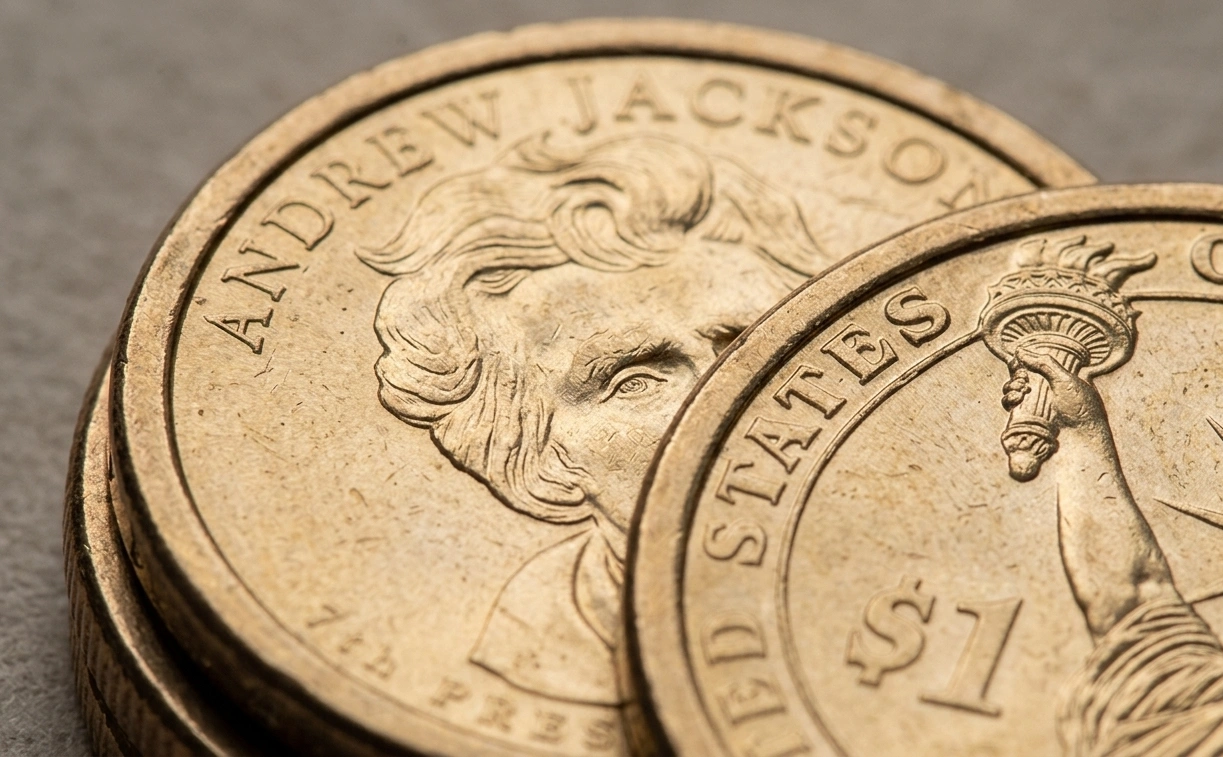
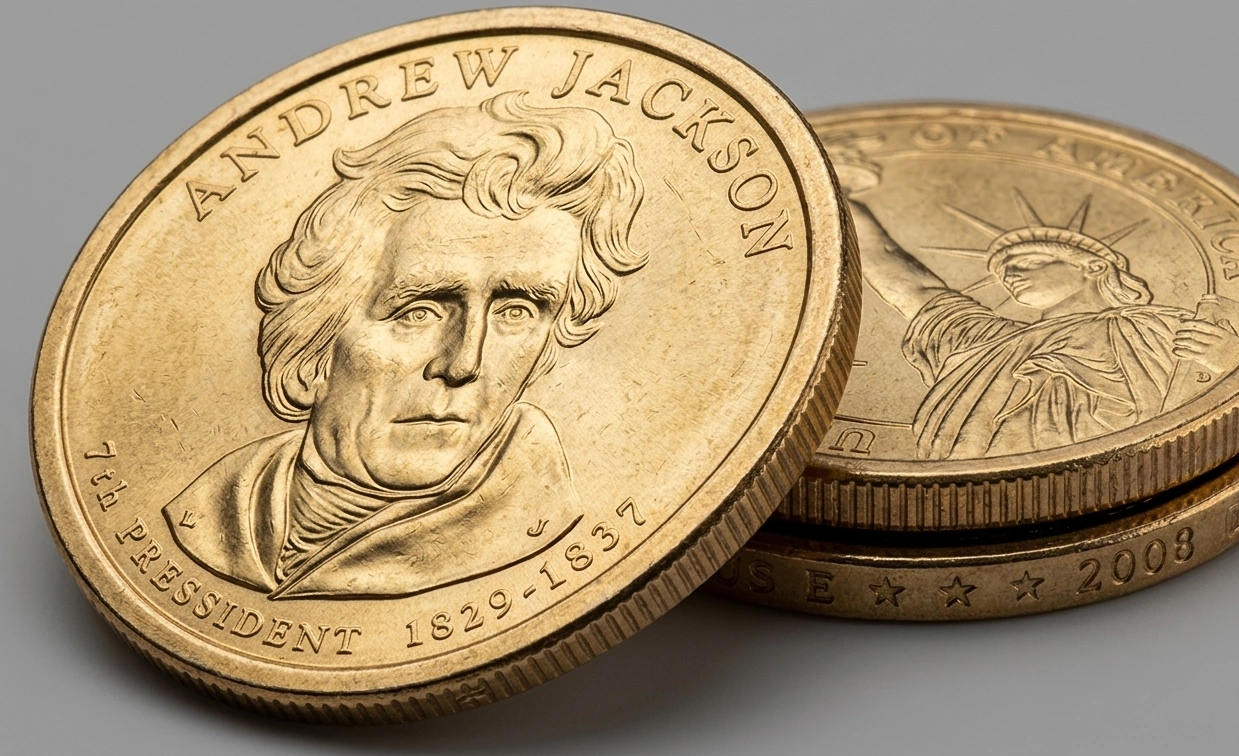
Such Andrew Jackson dollar coin circumstances dictated the initial intensity of coin use in commercial transactions.
Category | Specification |
Face Value | $1.00 |
Physical Mass | 8.1 grams |
Exterior Diameter | 26.5 mm |
Edge Thickness | 2.0 mm |
Core Material | 100% Copper |
Surface Material | Alloy containing Copper, Zinc, Manganese, and Nickel |
Rim Style | Lettered |
Strict adherence to the 8.1-gram mass serves as a primary authentication factor.
Weight fluctuations often indicate manufacturing flaws or counterfeit origin.
Manufacturing Volume and Distribution
Three main facilities shared the production load in 2008.
Philadelphia → 61,180,000 units
Denver → 61,070,000 units
San Francisco → 3,083,940 units
Total production volume exceeded 125 million pieces across all locations.
San Francisco's contribution represents less than 2.5% of the cumulative mintage.
This specific ratio determines the rarity of coins bearing the "S" mark in 2026.
Value Genesis in 2026
Market prices for this specific dollar show stability across several quality tiers.
Inflationary cycles observed in 2024–2025 pushed values higher for certified items.
Circulated coins → $1.00
State MS65 (Sheldon Scale) → $7.00 – $12.00
State MS67 (Sheldon Scale) → $45.00 – $75.00
State MS68 (Sheldon Scale) → $1,100.00 – $1,450.00
Annual growth rates for MS67 grade coins average 6% based on recent three-year data.
Low-grade specimens generally retain only their face value without upward trends, so examine your token via a free coin identifier.
Analysis of Rim Lettering Flaws
Minting technology for this series requires a secondary stage for applying edge text.
Specialized high-speed equipment performs this task after the faces are struck.
Occasional mechanical failures produce items highly sought by the market.
Total Absence of Lettering
Blanks bypassing the rim-lettering machine entirely. Market prices in 2026 reach $180.00.
Overlapping Text
Duplicate letters resulting from a second pass through the mechanism. Values range from $400.00 to $650.00.
Inverted Orientation
Symbols appearing upside down relative to the portrait. Commonly occurring, this variation constitutes a standard feature rather than an error.
Random placement within the edge-lettering device causes this directional difference.
2008 Issue Comparison
The 2008 series honored four distinct presidents.
Volume metrics for each issue appear in the following comparison.
President | Philadelphia (P) | Denver (D) | Cumulative Mintage |
James Monroe | 64,260,000 | 60,230,000 | 124,490,000 |
John Quincy Adams | 57,720,000 | 57,500,000 | 115,220,000 |
Andrew Jackson | 61,180,000 | 61,070,000 | 122,250,000 |
Martin Van Buren | 51,520,000 | 50,960,000 | 102,480,000 |
Jackson's dollar maintains a mid-tier position regarding availability.
Relative scarcity compared to the Monroe dollar sits at approximately 1.8%.
Surface Degradation and Metal Reactivity
Outer layers containing manganese react actively with the environment.
Oxygen exposure initiates a darkening process within months of circulation.
Oxidation cycle → color shift → loss of original luster.
Specimens retaining a golden hue in 2026 remain exceedingly rare.
Luster presence increases liquidity by 40% compared to tarnished counterparts.
Storage within inert polymer capsules effectively halts surface destruction.
2026 Auction Highs and Pricing Dynamics
Sales records from major trading platforms confirm the coin's status as a liquid asset.
Statistics reflect transactions recorded between 2015 and 2026.
Record for 2008-P (MS68 grade) → $1,175.00
Record for 2008-D (MS68 grade) → $950.00
Record for 2008-S (PR70DCAM grade) → $185.00
Missing edge lettering error (MS67 grade) → $520.00
High-tier prices climbed 15% during the last two-year cycle.
Market shrinking of flawless certified specimens drives this appreciation.
Expert Appraisal Workflow
Determining true value necessitates official professional grading.
The evaluation sequence includes:
Submission of the coin to an authorized lab like PCGS.
Microscopic surface inspection identifying tiny scratches.
Assessment of luster intensity and strike sharpness.
Numerical assignment on the 70-point scale.
Sealing the item inside a tamper-proof holder.
Grading costs in 2026 average around $35.00 per unit.
Coins valued below $40.00 generally do not justify the appraisal expense.
Market Demand Trends in 2026
Completion of the Presidential Dollar program in 2016 sparked interest in earlier dates.
Andrew Jackson's issue represents the peak of mass-circulation strikes.
Post-2011 issues exist only in limited collector-only quantities.
Government removal of surplus inventory from bank vaults continues reducing supply.
This ongoing withdrawal facilitates the disappearance of high-quality coins from public access.
Collector Sets and Specialized Logistics
The Mint released annual sets featuring a unique "Satin Finish."
These items possess superior strike characteristics.
Feature | Business Strike | Satin Finish |
Feeding Method | Bulk automatic | Individual careful handling |
Visual Appearance | Glossy luster | Matte surface |
2008 Set Mintage | Unlimited | 745,464 units |
2026 Price Range | $1.00 – $2.00 | $12.00 – $18.00 |
Satin Finish specimens have higher probabilities of achieving MS69 grades.
Value growth for matte coins remains slower than for flawless business strikes.
Risk Mitigation during Acquisition
The market for error coins attracts counterfeiters.
Missing edge lettering remains the most commonly faked defect.
Detection methods include:
Weight verification → metal removal drops mass to 7.9 grams.
Microscopic analysis of the rim for tooling marks.
Comparing rim color against the plated layers.
Check coin value via Coin ID Scanner
Precision digital tools provide the necessary accuracy for these checks.
Ownership Structure and Liquidity
Jackson dollars remain distributed among several holder categories.
Institutional/Bank Reserves → 45% (bags and rolls)
General Collectors → 30% (album storage)
Private Investors → 15% (certified slabs)
General Circulation → 10% (accidental use)
High liquidity exists for coins graded MS65 or lower.
Rare errors require longer marketing periods at specialized numismatic auctions.